























Strengthening Global Leadership Across EMEA, APAC, and the Americas to Navigate Manufacturing Volatility
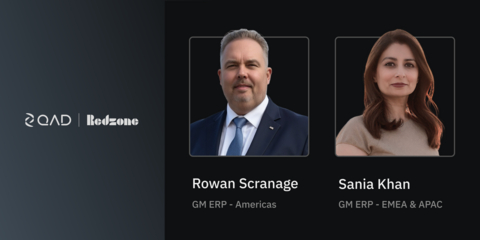
As manufacturers move beyond the limitations of traditional ERP systems, QAD | Redzone has announced two major executive appointments designed to accelerate the adoption of intelligent, adaptive supply chain solutions. Sania Khan has been named GM ERP for EMEA & APAC, while Rowan Scranage assumes the role of GM ERP for the Americas.

The appointments come at a critical juncture for the industry, as global manufacturers grapple with workforce shortages and supply chain disruptions that demand faster, AI-augmented decision-making.
In her new role leading the EMEA and APAC regions, Sania Khan is tasked with orchestrating go-to-market strategies across a diverse ecosystem of partners and manufacturers. Her focus is on moving organizations away from “black-box” legacy systems toward platforms that provide real-time, actionable insights.
“In today’s environment, companies need more than traditional ERP,” Khan noted. “By combining powerful technology with deep industry expertise, we are helping manufacturers build the agility and resilience needed to compete.” Her background at IBM and Medidata Solutions provides the enterprise-scale perspective required to manage these complex regional P&Ls.
On the other side of the Atlantic, Rowan Scranage will oversee revenue growth and market expansion across the Americas, while also leading global marketing for the ERP business. His partnership-first philosophy is aimed at tighter alignment between technical strategy and tangible customer value.
With a track record that includes leadership roles at Couchbase, Software AG, and IBM, Scranage is positioned to lead QAD’s end-to-end go-to-market architecture. “Manufacturers are entering a new era where AI, data, and operational execution must come together seamlessly,” he explained.
The common thread between these appointments is the industry-wide move toward Adaptive ERP. By embedding AI at the core of operations, QAD | Redzone is enabling a shift from reactive alert handling to proactive, outcome-driven management.
For the modern manufacturer, this transition isn’t just about software; it’s about operational autonomy. As AI begins to handle the heavy lifting of data correlation and supply chain forecasting, human leaders are freed to focus on high-level strategy and resilience.