

























The latest AV-TEST Advanced Threat Protection (ATP) evaluation puts 17 consumer and corporate security solutions through 10 grueling, real-world Windows 11 scenarios involving hijacked AutoIt scripts, revealing which defenses stand firm and where the margins for error are zero.
Detecting malware like ransomware and infostealers is only half the battle; the true test of an endpoint security solution is its ability to fend off an ongoing attack actively. The stakes are exponentially higher when threat actors stop relying entirely on custom binaries and instead co-opt legitimate, trusted administration tools, such as the Windows automation utility AutoIt, to carry out their misdeeds.
What happens when a security solution fails to recognize a hijacked utility, or worse, detects the intrusion but cannot stop the payload from executing? To answer these critical questions, the AV-TEST Institute conducts its bi-monthly Advanced Threat Protection (ATP) test. By subjecting security suites to 10 realistic, high-pressure attack scenarios under Windows 11, the evaluation measures whether a product can deploy its full defensive arsenal to neutralize active threats.
Keeping pace with the threat landscape is an uphill battle even for seasoned security professionals. The rapid proliferation of Ransomware-as-a-Service (RaaS) and dark web infostealer markets allows organized hacker syndicates to rent out their infrastructure to unskilled affiliates.
Whether dealing with prominent groups like Qilin, Play, Cl0p, RansomHub, or Akira, modern threat actors constantly refine their delivery routes and leverage artificial intelligence to adapt their malware. Recognizing this velocity, AV-TEST updates its ATP testing criteria every two months to mirror these evolving, real-world attack vectors.
AutoIt is a popular BASIC-like scripting language for Windows designed for automating keystrokes, mouse clicks, and window management. Because it is completely legal and digitally trusted for administrative tasks, deploying its interpreter or compiled EXE files rarely triggers immediate signature-based alarms.
In the test scenarios, attackers utilized AutoIt scripts implementing shellcode loaders designed to decode and execute malicious code directly inside the computer’s RAM, effectively simulating stealthy ransomware deployment and credential harvesting without leaving heavy file-based footprints.
Products were graded on a 35-point protection scale up to 3 points per detected ransomware sample and up to 4 points per infostealer, with deductions applied for partial blocks or system compromise.
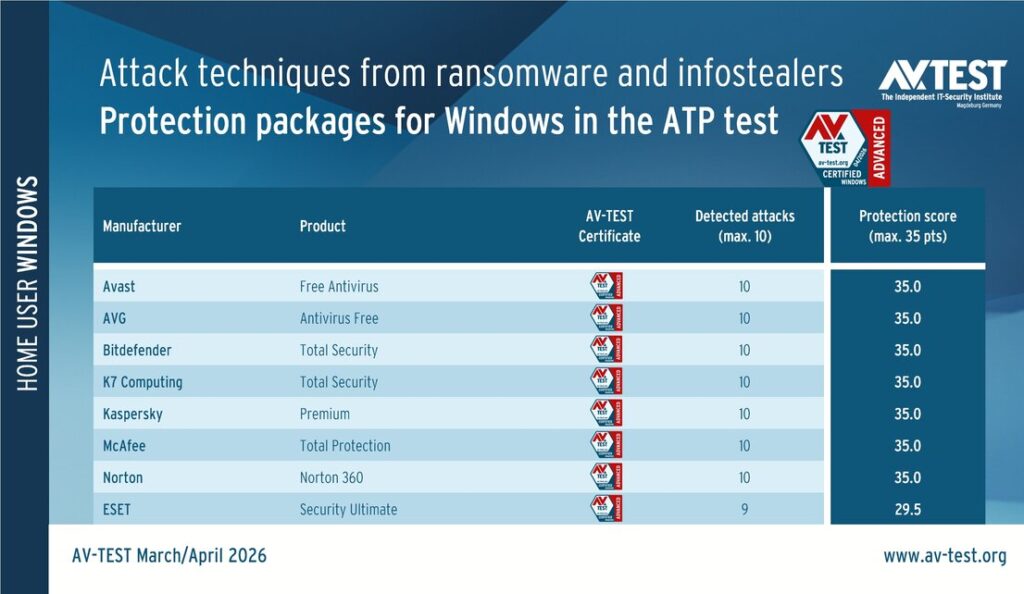
The consumer bracket evaluated 8 prominent security packages: Avast, AVG, Bitdefender, ESET, K7 Computing, Kaspersky, McAfee, and Norton.
- The Top Performers: Seven out of the eight packages, Avast, AVG, Bitdefender, K7 Computing, Kaspersky, McAfee, and Norton, aced the 10 scenarios with zero mistakes, earning the maximum 35 points and easily securing AV-TEST’s Advanced Certified certificate.
- ESET encountered isolated issues, including missing an infostealer entirely and failing to stop a ransomware strain that ultimately encrypted the test system. This resulted in point deductions, leaving ESET with 29.5 out of 35 points.
The corporate arena evaluated 9 endpoint security solutions designed for office environments: Acronis, Avast, Kaspersky (two variants), Microworld, Net Protector, Norton, Qualys, and Trellix.
- The Top Performers: Eight of the nine enterprise solutions, Acronis, Avast, Kaspersky, Microworld, Norton, Qualys, and Trellix, exhibited stellar performance, successfully repelling all 10 threat scenarios to claim a flawless 35 points and the “Advanced Approved Endpoint Protection” certification.
- Net Protector detected all 10 attackers initially, but struggled with quarantine and containment on two fronts, allowing a ransomware and an infostealer to partially bypass downstream modules and execute their payloads. Net Protector finished with 30.5 out of 35 points.
The March/April 2026 ATP results highlight robust research and development among the vast majority of security vendors, with 15 out of 17 packages successfully neutralizing sophisticated, RAM-resident threats. However, the minor stumbles observed in individual products prove that when dealing with aggressive ransomware and data-pilfering infostealers, there is zero margin for error, leaving vendors with a clear mandate to tighten their behavioral and process-monitoring modules further.